
Overview
mPower Social Enterprises Ltd., in collaboration with the University of Toronto as the research partner and SAJIDA Foundation as the implementation partner, is implementing a Wellcome-funded initiative to develop a culturally aligned Generative AI assistant for para-counselors providing frontline mental health support for anxiety, depression, and psychosis in Bangladesh. The 24-month implementation research project will evaluate the assistant’s usability, safety, cultural relevance, and potential to strengthen para-counselors’ capacity in low-resource community mental health settings.
Description
Problem
In Bangladesh, para-counselors often serve as the first point of support for people experiencing mental health challenges, especially in low-resource communities. However, they frequently work with limited training, supervision, and real-time decision support. Mental distress is also often expressed through local idioms, family pressures, social conditions, and culturally specific narratives that mainstream AI models may misinterpret.
How Our Solution Solves It
The project is developing a human-in-the-loop Generative AI assistant to support para-counselors in preparing for counseling sessions. Instead of replacing counselors or directly interacting with clients, the assistant helps frontline mental health workers interpret client narratives, identify possible patterns of distress, and prepare culturally appropriate guidance for follow-up sessions.
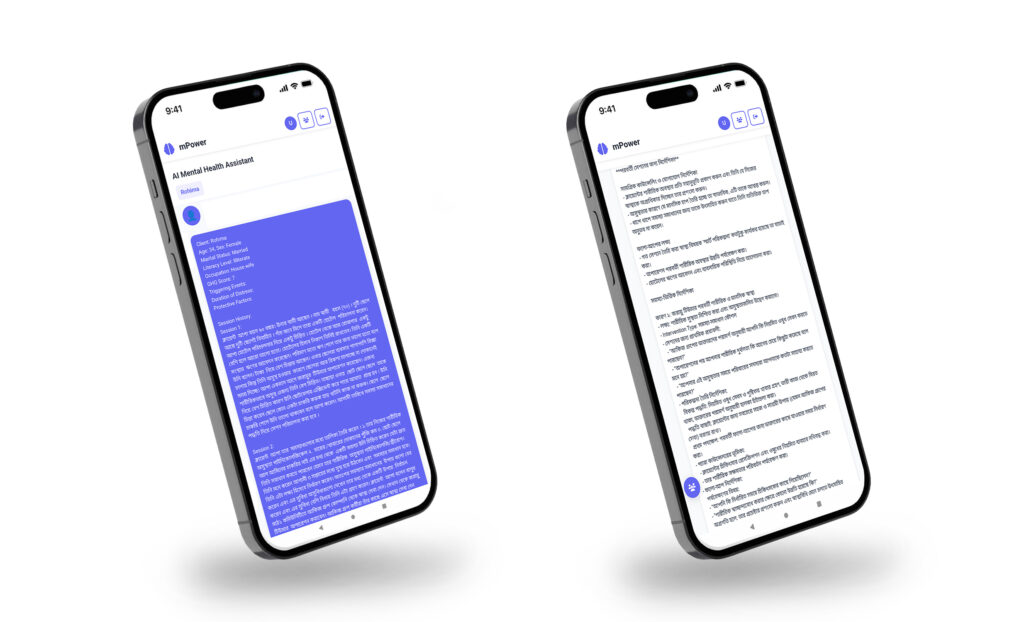
The solution combines Large Language Models, localized mental health knowledge, causal reasoning, and lived-experience insights. This allows the AI to go beyond symptoms and keywords by considering the social, cultural, family, economic, and emotional factors that shape how people in Bangladesh express anxiety, depression, and psychosis. Through knowledge graphs, GraphRAG, and CausalRAG approaches, the system is designed to provide more explainable, context-aware, and culturally grounded suggestions while reducing the risk of generic or misaligned responses.
mPower leads the technology and Human-Centered Design components, including LLM adaptation, knowledge graph integration, interface design, system testing, and field-level usability assessment. The solution is also being developed with responsible AI safeguards, lived-experience participation, expert review, and human oversight to ensure that para-counselors remain in control of the final decision-making process.
Results
The initiative has already completed a feasibility pilot using de-identified community mental health data from 402 clients, which helped refine the technical approach and identify risks of bias in raw program data. This learning informed the final solution architecture, shifting the model toward a more responsible Hierarchical Causal Knowledge Graph, GraphRAG, and CausalRAG-based framework. The final proposal has been accepted for a 24-month implementation research project across 10 sites in Bangladesh. The project will engage approximately 450 clients, generate 1,800–2,700 counseling session narratives, involve around 100 people with lived experience, 20 clinicians and cultural experts, and 15 para-counselors.